Best Laser Hair Removal Options for Dark Hair Explained

Editorial Team - MSN, FNP-C
Last Updated: November 14, 2026
Quick Summary
The best laser hair removal options for dark hair depend on skin tone as much as hair color. Nd:YAG lasers, with their longer wavelength, are most often considered for coarse dark hair on medium to deeper skin, while a provider should assess your skin and hair before choosing a device.
- Nd:YAG lasers use a longer wavelength, around 1064 nm, that is less strongly absorbed by surface melanin.
- Fine dark hair typically needs more sessions because there is less pigment for the laser to target.
- Always ask for a patch test before a full session, especially on deeper skin tones.
- Ask providers to name the device and its wavelength, not just say laser.
Table of Contents
- Why Dark Hair Responds Well to Laser, and Why Skin Tone Matters More
- Comparing the Best Laser Hair Removal Options for Dark Hair
- Laser Hair Removal for Fine Dark Hair: What to Expect
- Professional Treatment vs. Best Laser Hair Removal Options for Dark Hair at Home
- Safety Risks for Darker Skin: Burns, Pigment Changes and Patch Testing
- Choosing a Provider in Columbus, GA: Credentials, Consultation and Pricing Questions
- Booking Your Dark Hair Consultation at Selah Aesthetics and Wellness
- Frequently Asked Questions
Why Dark Hair Responds Well to Laser, and Why Skin Tone Matters More
Laser hair removal works best when the hair follicle holds enough pigment to absorb the light, and dark hair does exactly that. The challenge is that the same light is also absorbed by melanin in the surrounding skin, which is why the best laser hair removal options for dark hair depend as much on skin tone as on hair color.
Here is the core trade-off. Darker skin contains more melanin, so the laser has a greater chance of heating the skin's surface rather than the follicle. Longer wavelengths are designed to reduce that risk for people with darker skin.
Clinical guidance from the American Academy of Dermatology describes how laser and light-based hair reduction is typically evaluated by hair color, skin type and the device used American Academy of Dermatology laser hair removal guidance. Start with that framework before comparing devices.
Comparing the Best Laser Hair Removal Options for Dark Hair
Several devices are used for dark hair, and each suits a different combination of hair type and skin tone. Laser hair removal for dark hair is not one treatment but a set of options, and the right one depends on a consultation rather than a headline. Because hair and skin characteristics shape which approach is appropriate, a consultation can help determine whether laser hair removal services fit an individual’s needs.
The key variable is contrast: the difference between how much light the hair follicle absorbs and how much the surrounding skin absorbs. Dark hair on light skin gives the widest margin for error. Dark hair on deeper skin narrows that margin, because surface melanin competes with the follicle for the same energy. That is why the same device can be a strong choice for one patient and a poor choice for another, and why the device name alone tells you little without the settings and the operator.
Nd:YAG Laser for Dark Skin
The Nd:YAG laser uses a longer wavelength, around 1064 nm, that penetrates deeper into the follicle while being less strongly absorbed by surface melanin. That makes it the device most often considered for darker skin tones, and it is the option many practitioners reach for first when skin tone is medium-deep to deep and the hair is coarse and dark.
- Pros: Lower surface melanin absorption, a strong option for deeper skin tones, and effective on coarse dark hair.
- Cons: Typically needs more sessions, and results depend heavily on the operator's settings; the longer wavelength also means less pigment contrast on fine hair.
- Best for: Coarse dark hair on medium to deeper skin tones.
Alexandrite and Diode Lasers: Where They Fit
Alexandrite and diode lasers are used for dark, coarse hair, and their suitability depends on skin tone. A provider can explain which device fits your skin and hair.
Intense pulsed light (IPL) is sometimes offered as an alternative. Ask a provider to explain whether it is or is not recommended for your skin and hair.
Matching the Device to Hair and Skin Tone
A useful way to think about candidacy is to separate the two variables the query combines. Dark hair is an advantage because it gives the follicle more pigment to absorb. Dark skin is a constraint because it gives the surrounding tissue more pigment to absorb as well. The best outcomes come from devices and settings that maximize the first effect while minimizing the second.
A common pattern in practice is:
Watch out: A provider who recommends a device before assessing your skin type and hair texture, or who skips a patch test on deeper skin, is skipping the step that determines whether treatment is safe.
The table below summarises the devices and the trade-offs the article describes for dark hair.
| Device | Best for | Key difference |
|---|---|---|
| Nd:YAG laser | Coarse dark hair on medium to deeper skin tones | Longer wavelength (about 1064 nm), less surface melanin absorption |
| Alexandrite and diode lasers | Dark, coarse hair | Suitability depends on skin tone |
| Intense pulsed light (IPL) | Alternative option, if recommended | Ask a provider whether it suits your skin and hair |
| At-home devices | Lower-power, limited settings | Usually designed for lighter skin; check stated skin-tone range |
Laser Hair Removal for Fine Dark Hair: What to Expect
Fine dark hair is harder to treat than coarse dark hair because there is less pigment for the laser to target. Expect more sessions and realistic timelines.
Results also depend on the hair growth cycle. Treatment works best on hair in the active growth phase, which is why sessions are spaced several weeks apart. Maintenance treatments may be needed later.
Professional Treatment vs. Best Laser Hair Removal Options for Dark Hair at Home
At-home devices are widely sold, but their power and settings are limited, and they are usually designed for lighter skin.
Some at-home options are marketed for darker skin, so check the device's stated skin-tone range and the manufacturer's safety guidance before buying.
Safety Risks for Darker Skin: Burns, Pigment Changes and Patch Testing
The main risks for darker skin are burns, hyperpigmentation (darkening of the skin) and hypopigmentation (lightening). These can be persistent, which is why device choice and settings matter so much. You can also read about our other laser skin treatments and their safety considerations.
Watch out: Skipping a patch test is a common mistake. A small test area a few days before a full session shows how your skin reacts to the chosen settings.
A good provider will assess your skin type and tell you plainly if a device is not suitable. Pain, redness and temporary irritation can occur after treatment, and blistering or lasting pigment changes should be reported right away.
Choosing a Provider in Columbus, GA: Credentials, Consultation and Pricing Questions
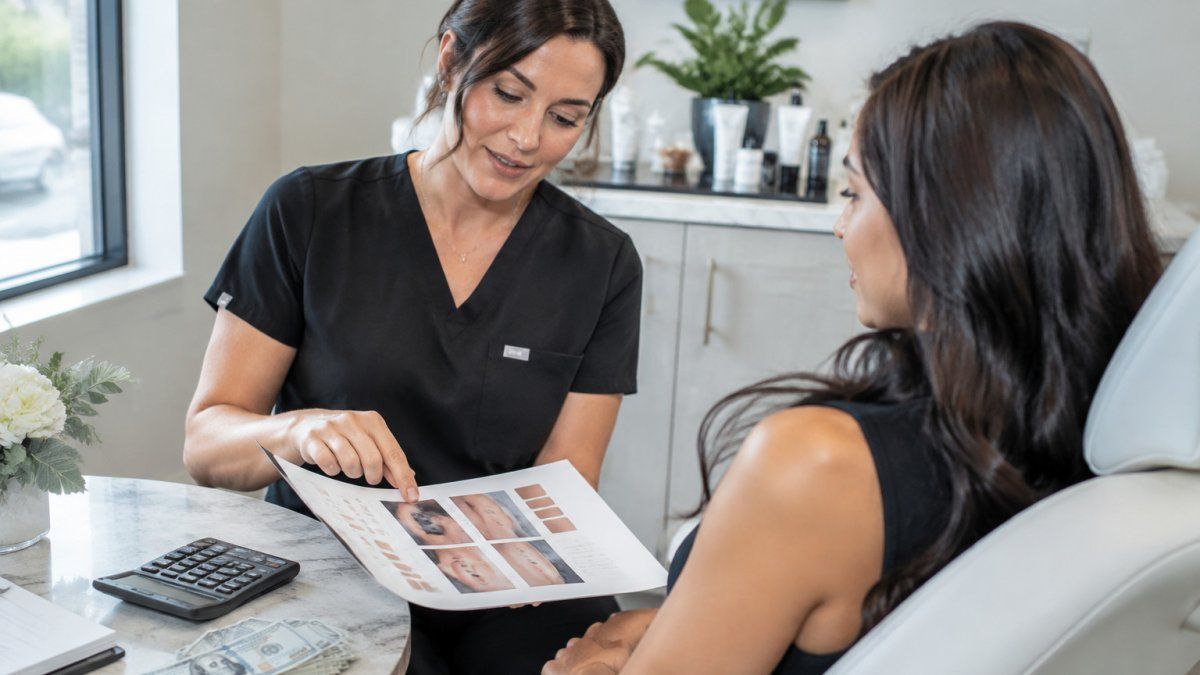
If you are looking for laser hair removal near me in Columbus, GA, start by asking who performs the treatment and what training they have. You can also compare the local medical spa options in Columbus before deciding. Ask whether a licensed healthcare professional oversees your care and whether they have experience treating your skin tone.
Use this checklist during a consultation:
- Who will perform the treatment, and what are their credentials? Ask whether a physician, nurse practitioner, physician assistant or licensed aesthetician operates the device, and who is available if something goes wrong.
- Which device do you recommend for my hair color and skin type, and why? Ask for the device's name and wavelength, not just "laser." A provider who can explain the wavelength and why it fits your skin tone is showing the reasoning that protects you.
- Will you do a patch test before the first full session? On deeper skin tones, ask whether a small test area is used before a full session to check settings.
- How many sessions do you expect, and how far apart should they be? Session spacing follows the hair growth cycle, and the total number depends on the treatment area and hair type.
- What does a package cost, and what is included? Pricing depends on the number of sessions and treatment areas, so ask for a written quote. You can also check our website for current prices.
- What is the plan if results are slower than expected? Ask whether additional sessions are included or charged separately, and what maintenance schedule the provider recommends after the initial series.
Compare providers on these answers rather than on price alone. A lower per-session price with a shorter package or a less suitable device can cost more overall than a slightly higher price with a plan built for your skin tone and hair type.
Watch out: A quote that does not specify the device, the number of sessions and what happens if results lag is not a comparable price, even if the dollar figure looks lower.
Booking Your Dark Hair Consultation at Selah Aesthetics and Wellness
The right device depends on your hair, your skin tone and your goals, and that is best determined in person. At Selah Aesthetics and Wellness in Columbus, GA, you can book a consultation to discuss your options. Book your dark hair consultation to start that assessment, or review our laser hair removal options before you decide.
BUTTON: Book Your Consultation CARD_TITLE: Which laser suits your dark hair and skin tone? CARD_TEXT: Selah Aesthetics and Wellness assesses skin type first, then recommends a device that fits.
Frequently Asked Questions
What type of laser hair removal is most effective for dark skin?
Nd:YAG lasers are generally the option most often discussed for darker skin tones because their longer 1064 nm wavelength is absorbed less by melanin in the skin's surface layers, which lowers the risk of burns and pigment changes. Alexandrite and diode lasers can work for some patients with darker skin, but they carry a higher risk when settings are too aggressive. Suitability depends on your skin type, hair color, and history, so a provider should assess these factors before any treatment begins. A patch test is a common first step.
Does laser hair removal work best on dark hair?
Laser hair removal works on dark hair because the device targets melanin in the hair follicle. Dark, coarse hair typically responds more predictably than light, fine, or gray hair, which contain less pigment for the laser to absorb. Results usually require multiple sessions spaced to match the hair growth cycle, and maintenance treatments may be needed over time. Results vary, so a consultation can help set realistic expectations for your specific hair and skin.
Is professional laser hair removal better than an at-home device for dark hair?
A provider can assess your skin tone and hair before recommending a device. At-home devices, including many IPL units, are often less powerful and may not be effective on darker skin or on fine dark hair. Using an at-home device on darker skin carries a higher risk of burns or pigment changes if settings are wrong. A professional consultation is a good place to start for a device recommendation.
How do I choose a laser hair removal provider?
Ask who will perform the treatment and what their training and licensing are, and confirm that a licensed healthcare professional oversees the care. Ask whether the provider assesses skin tone and hair color before choosing a device, and whether a patch test is part of the consultation. Request written pricing for the package you are considering and ask how many sessions are typically needed. A provider who discusses risks honestly and says no when a treatment is not a good fit is a strong sign of a trustworthy practice.

Lauren Hodge, MSN, FNP-C, is a board-certified Family Nurse Practitioner and aesthetic injector in Columbus, GA, with advanced training in regenerative medicine and aesthetics. She combines her background in pediatrics, pain management, and orthopedics with a passion for natural results, helping patients look and feel their best.
Share This Blog