7 Stress Management Habits That Support Skin Rejuvenation

Editorial Team - MSN, FNP-C
Last Updated: November 1, 2026
Quick Summary
Stress management for skin rejuvenation means calming the stress response so cortisol stays lower, the skin barrier stays strong, and collagen is protected. Small daily habits, deep breathing, short walks, meditation, and adequate sleep, support skin repair and reduce flare-ups.
- Cortisol weakens the skin barrier, so water escapes faster and irritants get in easier.
- Inflammation links stressful months to acne, rosacea, and eczema flare-ups.
- A brisk 20-minute walk lowers stress hormones and boosts circulation for skin repair.
- Protect sleep with a consistent bedtime, dimmed screens, and no caffeine after early afternoon.
- During a flare-up, simplify to cleanser, moisturizer, and sunscreen before adding actives back.
Table of Contents
- How Stress Affects Skin: Cortisol, Inflammation, and Collagen
- Stress Relief Techniques for Skin Health You Can Start This Week
- Sleep and Skin Health: The Repair Window Most People Skip
- The Skincare Routine for Stressed Skin That Won't Backfire
- A Time-Based Stress Management Plan for Busy Weeks
- How to Track Stress and Skin Changes Without Guessing
- Realistic Expectations and When to Seek Professional Care
- Book a Consultation at Selah Aesthetics and Wellness
- Frequently Asked Questions
How Stress Affects Skin: Cortisol, Inflammation, and Collagen
Stress management for skin rejuvenation starts with understanding one fact: your skin reacts to stress faster than almost any other organ. Stress often shows up on the skin as dull tone, sudden breakouts, or redness that appears during a hard season.
Stress hormones drive much of that change.
What Cortisol Does to the Skin Barrier
Cortisol is your body's primary stress hormone. When levels stay high, the skin barrier weakens. Water escapes faster, irritants get in easier, and skin feels tight, reactive, and rough.
The barrier is your skin's outer shield. When it fails, everything downstream gets harder: hydration, healing, and collagen support.
Why Flare-Ups Show Up When Life Gets Loud
Inflammation is the link between a stressful month and a red, angry face. Stress hormones ramp up inflammatory signals, so skin conditions like acne, rosacea, and eczema tend to flare when deadlines stack up.
Oxidative stress adds to the damage. It breaks down collagen, the protein that keeps skin firm. Less collagen means fine lines look deeper and skin loses bounce.
Harsh scrubs or strong acids can make a stress flare worse, since a compromised barrier is more easily irritated.
Stress Relief Techniques for Skin Health You Can Start This Week
Stress relief techniques for skin health work best when they are small, repeatable, and matched to your actual schedule. Ten focused minutes a day beats an ambitious plan you abandon by Thursday. The techniques below are grouped by effort level so you can pick what fits, not what sounds impressive.

Breathing, Meditation, and Mindfulness in 10 Minutes a Day
Deep breathing is the fastest lever you have. Slow, belly-deep breaths signal safety to your nervous system, which lowers stress hormone output over time. A simple daily sequence:
- Sit comfortably and close your eyes.
- Breathe in for a count of four.
- Hold for four counts.
- Breathe out for six counts.
- Repeat for five minutes.
Meditation and mindfulness add a second layer. Five minutes of quiet attention, noticing your breath without judging it, helps calm the thought patterns that keep tension running all day. Guided apps make the habit easier to keep, but they are not required, a timer and a chair work.
Movement, Therapy, and the Thought Patterns Behind Tension
Exercise lowers stress hormones and boosts circulation, which supports skin repair and renewal ( ncbi.nlm.nih.gov). A brisk 20-minute walk counts. So does a dance class or a swim. Strength training is one form of exercise that many people include in a routine for overall wellness.
Cognitive behavioral therapy targets the thought patterns that fuel chronic tension. A therapist helps you catch a stressful thought, test it, and replace it. For people whose stress runs constant, talking with a therapist can be a helpful part of overall wellness.
If Meditation or Exercise Isn't for You
Adherence is the real bottleneck. A common pattern is starting a meditation habit, missing two days, and quitting entirely. Alternatives that still lower stress load:
- Creative or manual tasks , knitting, gardening, cooking, or playing an instrument occupy attention the way meditation does.
- Social connection , a 15-minute phone call with a friend can be a supportive way to ease stress.
- Nature exposure , a walk in a park, even short, combines movement and attention restoration.
- Journaling , five minutes of writing down what is worrying you externalizes rumination.
- Household routines , folding laundry or washing dishes mindfully is a legitimate mindfulness practice.
A Realistic Weekly Rhythm
Rather than a rigid daily checklist, build a weekly rhythm with one anchor habit per day:
| Day | Anchor Habit | Time |
|---|---|---|
| Monday | Box breathing before work | 5 min |
| Tuesday | Walk outside at lunch | 20 min |
| Wednesday | Guided meditation | 10 min |
| Thursday | Strength or cardio | 30 min |
| Friday | Social call or creative task | 15 min |
| Weekend | One longer walk or class | 30-45 min |
Start with one row. Add another when the first feels automatic. Consistency tends to matter more than intensity when building a new habit.
If you want to extend these habits into a full treatment-prep plan, our guide on building wellness habits before aesthetic treatments walks through it step by step.
Sleep and Skin Health: The Repair Window Most People Skip
Sleep and skin health are tightly linked, and most people sacrifice one to protect the other. Many people find that good sleep supports overall skin appearance.
Skip that window and the cost shows up fast: dull tone, dark circles, and slower healing.
Protect sleep with a short routine:
- Set a consistent bedtime, even on weekends.
- Dim screens an hour before bed.
- Keep the room cool and dark.
- Skip caffeine after early afternoon.
Adequate sleep is an important part of a healthy skin routine.
The Skincare Routine for Stressed Skin That Won't Backfire
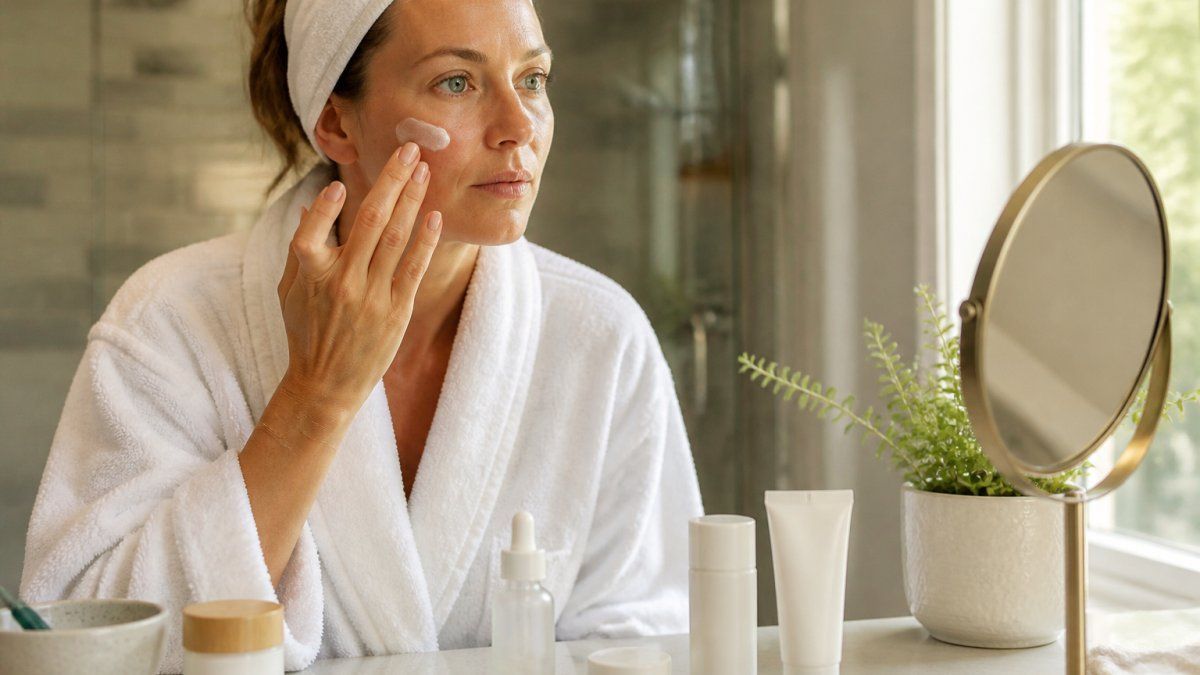
A skincare routine for stressed skin should calm and support, not attack. The goal is to protect the barrier while the stress response settles, because a compromised barrier makes every active ingredient riskier and every flare-up more likely.
Gentle Cleansing, Barrier Support, and Fragrance Minimization
Gentle cleansing means a mild, non-foaming cleanser used twice daily. Skip hot water and washcloths that scrub.
Barrier support means moisturizers with ceramides, plus a daily sunscreen. Moisturizers containing ceramides are a common choice for supporting the skin barrier. The American Academy of Dermatology's sunscreen guidance explains why daily use matters more than high SPF on beach days.
Fragrance minimization means choosing calming formulas without added perfume, which is a common trigger for sensitivity and redness. This matters more during flare-ups than at baseline.
Antioxidants help too. A varied diet with fruits and vegetables is part of overall wellness. If you want to lock in long-term habits, our list of preventive skincare habits for long-term skin health pairs well with this routine.
Stress Habits That Sabotage Your Skin
The behaviors that show up during stressful weeks often do more damage than the stress itself:
- Picking and touching , stress increases face-touching. Hands transfer bacteria and picking turns a small clog into a mark that lasts months.
- Over-exfoliating , when skin looks dull, the instinct is to scrub. During a stress flare, acids and scrubs strip an already weakened barrier and prolong redness.
- Product-hopping , buying a new active every week means you never learn what works and you stack irritants. Give one change two to three weeks before adding another.
- Skipping sunscreen , stressed, sleep-deprived skin repairs more slowly, so UV damage compounds faster.
- Hot showers , a common stress-relief habit that strips barrier lipids. Lower the temperature on your face even if you keep the shower warm.
A Minimal Routine That Holds Up Under Stress
| Step | Morning | Evening |
|---|---|---|
| Cleanse | Gentle cleanser or water rinse | Gentle cleanser |
| Treat | Vitamin C serum (if tolerated) | Barrier serum or none during flares |
| Moisturize | Ceramide cream | Ceramide cream |
| Protect | Broad-spectrum sunscreen | , |
When at-home care is not enough, a professional consultation can help you decide on next steps. Watch out: layering new actives every week is the most common mistake we see. Give one change two to three weeks before adding another.
A Time-Based Stress Management Plan for Busy Weeks
Most stress plans fail because they assume free time you do not have. This one fits real schedules.
| Time | Habit | Frequency | Skin Benefit |
|---|---|---|---|
| 5 minutes | Box breathing | Daily | Lowers stress hormones |
| 10 minutes | Walk outside | 5 days a week | Boosts circulation |
| 15 minutes | Meditation app | Daily | Calms thought patterns |
| 30 minutes | Strength or cardio | 3 days a week | Supports collagen |
| 7-8 hours | Sleep window | Nightly | Powers skin repair |
Start with one row. Add another when the first feels automatic. Adherence beats intensity every time.
How to Track Stress and Skin Changes Without Guessing
Tracking turns vague feelings into patterns you can act on. Keep it simple, or you will quit.
- Rate stress 1-10 each evening
- Note sleep hours
- Photograph skin weekly in the same light
- Log flare-ups with a one-line note
- Review monthly for connections
After a month, patterns usually appear. Maybe breakouts follow short sleep. Maybe redness spikes after high-stress workweeks. Once you see the link, you can target the cause instead of guessing at products.
Realistic Expectations and When to Seek Professional Care
Stress management can support skin appearance, but it is not a substitute for professional treatment. Evidence on stress and skin continues to grow, and the National Institutes of Health's overview of stress research is a good starting point for understanding the science.
Seek professional care when:
- Flare-ups persist despite a calm routine
- Redness or acne leaves marks
- Fine lines and laxity bother you more than stress alone explains
- Hormonal symptoms like fatigue or irregular cycles appear
At Selah Aesthetics and Wellness, every patient starts with Selah Face Value, a head-to-toe consult with AURA facial analysis and a layer-by-layer look at bone, fat, muscle, and skin. Judgment comes before technology, and a treatment is recommended only when it is appropriate. If you are weighing options, our article on enhanced natural beauty versus improved well-being helps frame the decision.
Book a Consultation at Selah Aesthetics and Wellness
You can build the habits above and still wonder whether something deeper is driving your skin. That uncertainty is worth a conversation, not another online order.
We do expensive faces: built, not overfilled. Selah Aesthetics and Wellness offers regenerative and personalized wellness services, with care provided by licensed healthcare professionals.
Get started with Selah Aesthetics and Wellness and book a consultation to find out what your skin actually needs. Reach our team through our contact page whenever you are ready.
Frequently Asked Questions
How does stress affect the skin?
Stress triggers cortisol and other stress hormones that can weaken the skin barrier, raise inflammation, and speed collagen breakdown. In practice, that shows up as redness, sensitivity, breakouts, and dullness. Stress management supports skin rejuvenation by lowering that hormonal load so repair can happen.
What stress relief techniques for skin health are worth trying first?
Start with the ones you will actually repeat: five to ten minutes of deep breathing or meditation, a daily walk, and a consistent bedtime. Cognitive behavioral therapy can help when thought patterns keep you in a stress loop. Gentle hands-on relaxation is another option if you want it.
How much sleep do adults need for healthy-looking skin?
Most adults need seven to nine hours. Good sleep supports overall wellness, and many people notice their skin looks better when they rest well.
When should I see a dermatologist about stress-related skin changes?
See a professional if redness, acne, or sensitivity persists for more than a few weeks, worsens despite a gentle routine, or comes with pain, spreading rash, or sudden hair loss. A qualified healthcare professional can evaluate persistent skin concerns and discuss appropriate options. Book a consultation at Selah Aesthetics and Wellness to review what fits your skin.
Your skin has been telling you something for months. The next step is finding out what, with someone who assesses before recommending and tells you the truth about what you need.

Lauren Hodge, MSN, FNP-C, is a board-certified Family Nurse Practitioner and aesthetic injector in Columbus, GA, with advanced training in regenerative medicine and aesthetics. She combines her background in pediatrics, pain management, and orthopedics with a passion for natural results, helping patients look and feel their best.
Share This Blog